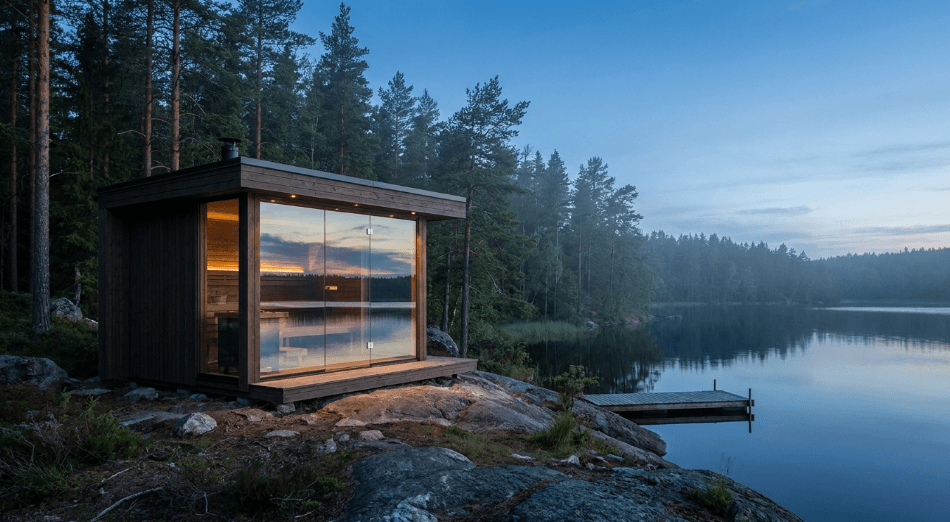
An outdoor sauna that gets routine care, wiping down surfaces after use, replacing heater rocks every one to two years, and resealing exterior wood every one to three years, typically holds up for 15 to 25 years before major parts need replacing. Skip that care for two or three seasons and the repair bill can run well past $1,000, compared with roughly $50 to $150 a year spent on basic supplies. For a first-time buyer, knowing this ahead of time changes which wood species, roof design, and site placement actually make sense.
What Makes an Outdoor Unit Harder to Maintain Than an Indoor One?
An indoor sauna lives inside a climate-controlled house and never sees rain, snow, or direct sun. An outdoor cabin sits exposed to all three, plus freeze-thaw cycles that can crack caulking and swell wood joints if water gets trapped somewhere it cannot escape. The roof and exterior walls need a weather-rated sealant reapplied every one to three years depending on climate, more often in regions with intense sun or salt air near the coast. The base matters more outdoors too: a gravel or paver pad that drains water away from the floor framing prevents the slow rot that never shows up until a floor board goes soft underfoot. None of this is hard to manage, but an outdoor buyer is signing up for a slightly longer maintenance list than someone installing a cabin in a finished basement.
What Should a First-Time Buyer Budget for Annual Upkeep?
Plan on $50 to $150 a year in consumables for a typical two- to four-person outdoor unit: a wood-safe cleaner, a shop vacuum for heater vents, and exterior sealant applied on a one- to three-year rotation. Heater rocks run $30 to $80 for a full replacement set and need swapping every one to two years with regular use, sooner if they develop a chalky white crust from mineral buildup in hard water areas. Door seals last two to four years before compression sets in, closer to two years in units that see daily use. Buyers comparing new units side by side often start by looking at a specialty retailer’s current lineup, including SweatDecks, before deciding whether a lower-maintenance infrared cabin is worth the tradeoff against a traditional wood-fired build that needs more frequent attention to the heater and rocks. Either way, the ongoing cost is modest compared with what a neglected unit eventually costs to repair.
What Wood and Hardware Choices Cut Down on Long-Term Maintenance?
Cedar and heat-treated hemlock both resist rot reasonably well outdoors, but heat-treated hemlock’s manufacturing process pulls moisture and sugars out of the wood, which makes it more dimensionally stable in humid or rainy climates and less prone to the graying that cedar develops within a year or two of steady sun exposure. Stainless steel hardware costs more up front than galvanized but does not develop the rust streaks that galvanized fasteners eventually leave on light-colored wood siding. A roof with a real overhang, at least a few inches past the walls, keeps rain off the siding and door seal far better than a flush roofline, which cuts down on how often exterior sealant needs reapplying. None of these choices are dealbreakers if skipped, but each one shaves meaningful hours off the maintenance calendar over a decade of ownership.
What Should Be Checked Before You Buy, Not After?
Confirm the electrical requirement before ordering: larger heaters, roughly 6kW and up, typically need a dedicated 240V circuit, which means an electrician visit if the yard does not already have one nearby. Check local setback rules for structures near property lines, since some municipalities regulate outdoor saunas the same way they regulate sheds or other accessory structures. Look at the ventilation design as well. A cabin with a proper intake vent near the heater and an exhaust vent placed higher clears humidity between sessions far faster than one relying on the door alone, and that faster drying is what keeps mold from ever getting a foothold in the wood grain.
What Mistakes Do First-Time Outdoor Owners Make?
The most common one is skipping the pad or gravel base and setting the unit directly on dirt or grass, which traps moisture against the floor and speeds up rot in exactly the spot that is hardest to inspect later. A close second is cleaning with bleach or strong solvents instead of a mild, wood-safe product, since harsh chemicals strip the natural oils that give cedar and hemlock their water resistance in the first place. Ignoring the door seal until it visibly fails is another common one. A seal that has quietly lost half its compression makes the heater run longer to reach the same temperature, which adds up in electricity cost long before anyone notices the seal itself needs replacing.
Does Consistent Maintenance Support the Benefits Researchers Report?
A sauna that reliably holds its rated temperature is what actually supports the kind of regular use tied to the health associations researchers have measured. A 2018 review in Mayo Clinic Proceedings summarized cardiovascular associations linked to frequent sauna use across multiple long-running cohorts, and a 2018 systematic review in Evidence-Based Complementary and Alternative Medicine reported similar patterns tied to how consistently people used a sauna over time. Older clinical literature going back to 2001 makes a related point: the benefits described in these studies come from steady, repeated sessions, not occasional use of a unit that struggles to reach temperature because of a worn seal or poorly performing rocks. Viewed that way, upkeep is not just a cost-avoidance habit, it is part of getting real use out of the investment.
What Seasonal Tasks Actually Prevent the Biggest Repair Bills?
Twice a year, ideally at the start and end of the heaviest-use months, walk the exterior and check hinges, latch alignment, and any visible caulking around windows or vents. Vacuum dust and debris out of heater vents and the floor around the rock bed, since buildup there restricts airflow and makes the heater work harder than it should. On outdoor cedar or hemlock units specifically, look for graying or surface checking that signals the exterior sealant is due, typically every one to three years depending on how much direct sun and rain the site gets. Owners who keep to this twice-a-year rhythm rarely see the moisture-driven repairs that make up most of the expensive fixes on neglected units, since almost every serious problem traced back far enough starts with water that had nowhere to drain or dry.
Frequently Asked Questions
How long does a well-maintained outdoor sauna typically last? Fifteen to 25 years for the cabin structure when it gets routine wipe-downs, seasonal seal checks, and exterior resealing every one to three years. Heaters often need replacement sooner, in the 10 to 15 year range.
How often should exterior wood be resealed on an outdoor unit? Every one to three years depending on climate, sooner in regions with intense sun, heavy rain, or salt air. Graying or a rough dry texture signal it is due.
Does an outdoor sauna need a special foundation? A gravel or paver pad that drains water away from the floor framing is strongly recommended rather than setting the unit directly on soil or grass.
What is the single most important maintenance habit for outdoor units? Wiping down interior surfaces and leaving the door open to dry fully after each session, since trapped moisture drives most warping and mold problems.
References
- Cardiovascular and Other Health Benefits of Sauna Bathing: A Review of the Evidence, Mayo Clinic Proceedings, 2018
- Clinical Effects of Regular Dry Sauna Bathing: A Systematic Review, Evidence-Based Complementary and Alternative Medicine, 2018
- Benefits and risks of sauna bathing, The American Journal of Medicine, 2001
